
By goalLet through, warn, or hold for approval
Give credit on your terms, not by accident
Every order is checked against what the customer owes and the limit in your books. You decide what happens next: let it through, warn, or hold it until someone with the right approves.
What changes
The same job, before and after
Checking a limit
Today: Someone remembers to look at the ledger, on a good day.
With Kavasa: Every order is checked by itself, wherever it was placed.
An order over the limit
Today: Dispatched, and noticed at the end of the month.
With Kavasa: Held with the reason shown, until a person with the right approves it.
Who may approve
Today: Whoever picks up the phone.
With Kavasa: Only the people you give the right to, and each approval is on record.
How it works
What does the work
Limits and dues from your books
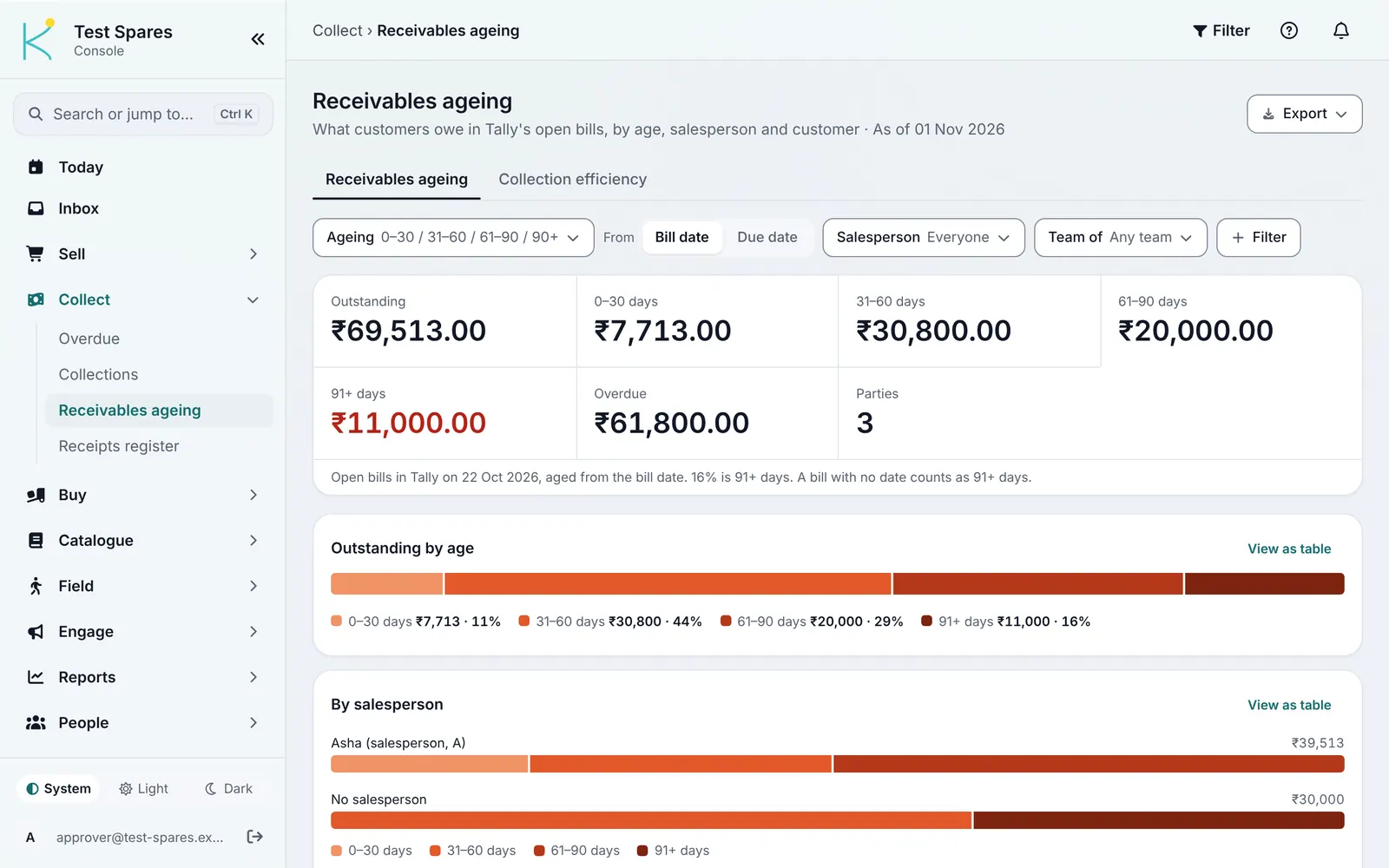
The customer's credit limit and open bills are read from your accounting software, so the check uses the same figures as your accountant.
Your rule for each case
Over the limit, or with a bill overdue past the days you choose: let the order through, warn, or hold it.
Approval with a name on it
A held order waits for a person with the approve right. Who approved it, and when, stays in the audit trail.
The customer and the salesperson see why
The customer sees their unpaid bills in the app, and the salesperson sees the balance before taking the order.
Post-dated cheques
Customers' cheques with their dates, deposits and bounces, where you take them.
The apps that do it
Named last, as they should be
- The office
Console
Catalogue, pricing, customers, orders, collections, purchasing, reports and rights.
- Your customers
Customer app
Your own app in your brand. Customers order at their own price and see their account.
- Sales team
Kavasa Field
Routes, visits, orders, collections and expenses from the phone.
- Owners and managers
The nightly watch
Every night each figure is compared with its own usual range. You hear what is unusual.
Where is a customer's credit limit set?
In your books, as today. Kavasa reads the limit and the open bills and checks every order against them.
Can we hold orders only for badly overdue customers?
Yes. You choose the rule: by the limit, by how many days a bill is overdue, or both, and whether to warn or to hold.
We sell only for cash. Do we need this?
No. Giving credit is a module you leave off, and its limits, holds and collections screens stay out of the way.
The rest is in our privacy policy and terms of use.
See your own business in Kavasa
A walkthrough with your items, your customers and your prices.
How you start